
Goldman’s 2027 price outlook and Escondida’s longer timetable
Goldman Sachs’ higher copper-price outlook produces a large earnings sensitivity for BHP. The proposed Escondida concentrator, however, will be judged on how much mine output and cash flow it preserves over a much longer period.
Goldman’s forecast refers to 2027, while BHP expects the replacement concentrator to begin producing in 2031–32. Stronger prices in the nearer term could leave BHP with more capacity to fund the project, but the construction decision turns on costs, continuity of production and the cash generated over the asset’s life.
Illustrative change in underlying EBITDA, holding BHP’s FY2026 copper exposure constant and applying the reported Goldman forecast revision.
Advance engineering and permits while comparing costed options before committing construction capital.
A $1,600/t price revision implies $2.83bn of EBITDA sensitivity
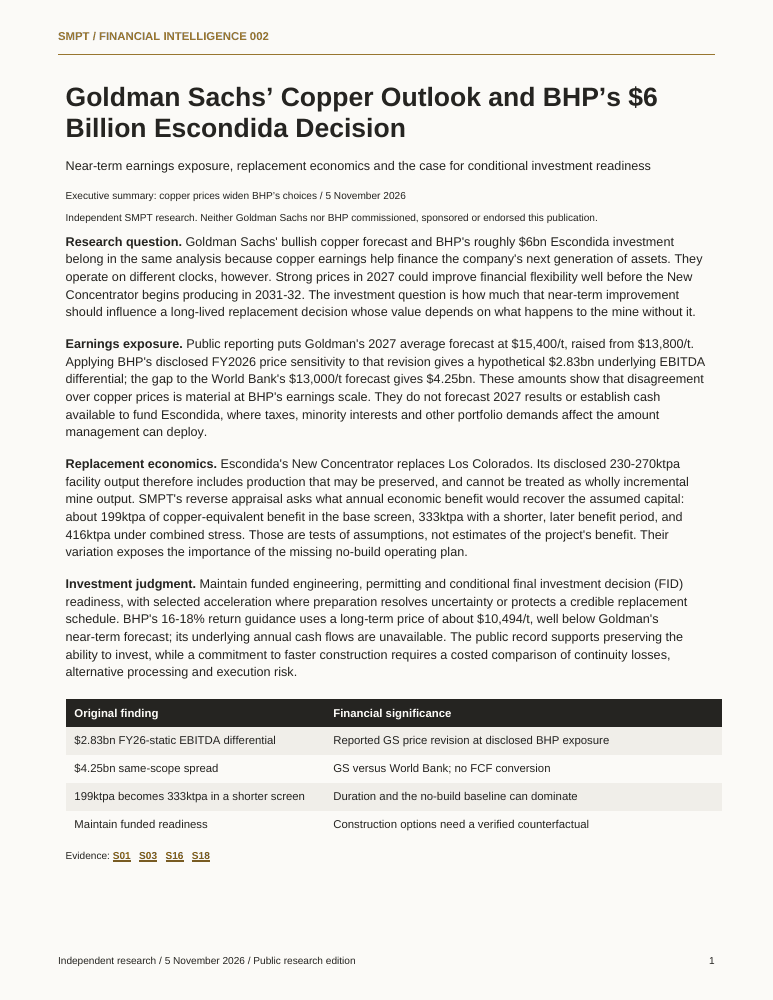
Public reporting puts Goldman’s average copper-price forecast for 2027 at $15,400/t, up from $13,800/t. The World Bank’s October forecast for the same year is $13,000/t. Applied to BHP’s disclosed sensitivity of $39 million in underlying EBITDA for each US cent/lb movement in copper prices, the difference between Goldman’s old and new forecasts corresponds to $2.83 billion; the difference between Goldman and the World Bank corresponds to $4.25 billion.
Calendar-2027 copper-price forecasts
US dollars per tonne · calendar-2027 annual average
$1,600/t price difference
$2,400/t price difference
Sources: FinancialJuice, 20 October 2026; World Bank, October 2026, Table 1; BHP FY2026 presentation, slide 48. Stratellar calculations. The Goldman annual average comes from public reporting; the original research note remains unavailable. Goldman’s separate $15,600/t end-2027 view has a different horizon.
Both figures hold BHP’s FY2026 copper exposure constant. They illustrate the scale of the price difference rather than predict earnings or cash available for construction, which would also depend on volumes, costs, taxes and distributions. BHP holds a 57.5% economic interest in Escondida but fully consolidates the operation, so Group EBITDA sensitivity cannot simply be multiplied by the ownership percentage.
The concentrator’s value depends on the production it preserves
The planned New Concentrator would replace Los Colorados. BHP estimates gross capital spending of $5.4–6.3 billion and a facility output of 230–270 ktpa. That production figure describes the proposed plant; it is not automatically a net increase in Escondida’s output. The investment benefit depends on what the mine could produce without the replacement and how the build and no-build plans differ in cost.
Using assumed prices, margins, spending and project timing, the model works backward from the capital cost to estimate how much annual production-equivalent benefit would be needed to recover it. Across four cases, the requirement ranges from 199 to 416 ktpa.
Required annual production-equivalent benefit
Estimated output preserved or added against a no-build mine plan
Required production-equivalent benefit
199 ktpa
In the base case, the model spreads the benefit over 20 years from 2032. It assumes the same annual amount of production preserved or added throughout that period.
- Gross capital
- $5.85bn
- Long-term copper
- $10,494/t
- Benefit period
- 20 years · 2032–51
- Annual after-tax benefit
- $839m
All four scenarios and assumptions
| Scenario | Benefit period | Required ktpa |
|---|---|---|
| Base | 20 years · 2032–51 | 199 |
| Shorter benefits | 10 years · 2032–41 | 275 |
| Shorter, later | 10 years · 2034–43 | 333 |
| Combined stress | 20 years · 2034–53 | 416 |
The model starts from an end-2026 valuation date and assumes a 10% nominal discount rate, five equal year-end capital draws in 2027–31, a $4,000/t all-in net burden and a 35% cash-tax wedge. Price and contribution stay flat in nominal dollars, with ramp-up and terminal value excluded. The workbook has six scenarios and further sensitivities; the four shown here test changes in benefit duration, timing and costs.
Source: Stratellar reverse appraisal, published sensitivity calculations (CSV). The required benefit can come from output preserved or added relative to a no-build mine plan. These screens show what the project would need to recover capital under the stated assumptions. A full assessment would also require a mine-wide comparison of cash flows with and without the new concentrator.
BHP has guided to a 16–18% project return using a long-term copper assumption of approximately $10,494/t, well below the reported Goldman 2027 average. Public disclosures do not provide the full annual cash-flow schedule or a costed plan for operating the mine without the replacement concentrator. The simplified model therefore tests capital recovery under stated assumptions; it is not a reproduction of BHP’s internal-rate-of-return calculation.
Project estimates: BHP FY2026 results presentation, slides 19–22 and 35–36. All capital and equivalent-benefit screens above use a gross project basis. Applying the same 57.5% ownership factor to both sides cancels in the ratio.
Keep engineering and permitting moving before construction approval
In its October operating review, BHP reported $0.8 billion in gross pre-commitment funding approved for engineering, permits and execution readiness. That approval is for preparatory work; it does not establish that the full amount has been spent or that construction has received final sanction. Continuing the work that resolves major uncertainties can protect the replacement schedule while BHP evaluates when to commit the larger investment.
Case for accelerating construction
Faster construction could make sense if the value of avoided production losses exceeds the extra cost and execution risk, provided permits and a workable schedule are in place.
Case for delaying construction
A delay could make sense if a workable interim mine plan preserves more value than would be lost through deterioration, cost escalation or missed production.
Evidence needed before sanction
Before sanction, BHP would need a costed mine plan without the replacement, annual production and tax schedules, feasible execution alternatives and the relevant permitting conditions.
Higher copper prices may give BHP more financial room to proceed, but the concentrator still competes with other uses of capital. That comparison needs project-level returns and credible alternatives. Historical cash flow, management projections and gross project budgets each cover different periods and scopes, so an EBITDA sensitivity should not be read as money immediately available to spend.
Readiness source: BHP quarterly operating review, 20 October 2026, pp. 1–2. The indexed Chilean permitting file showed evaluation pending at the research cutoff, including a 4 November applicant request. Document-access limits leave the approval date and potential delay probability unresolved.